


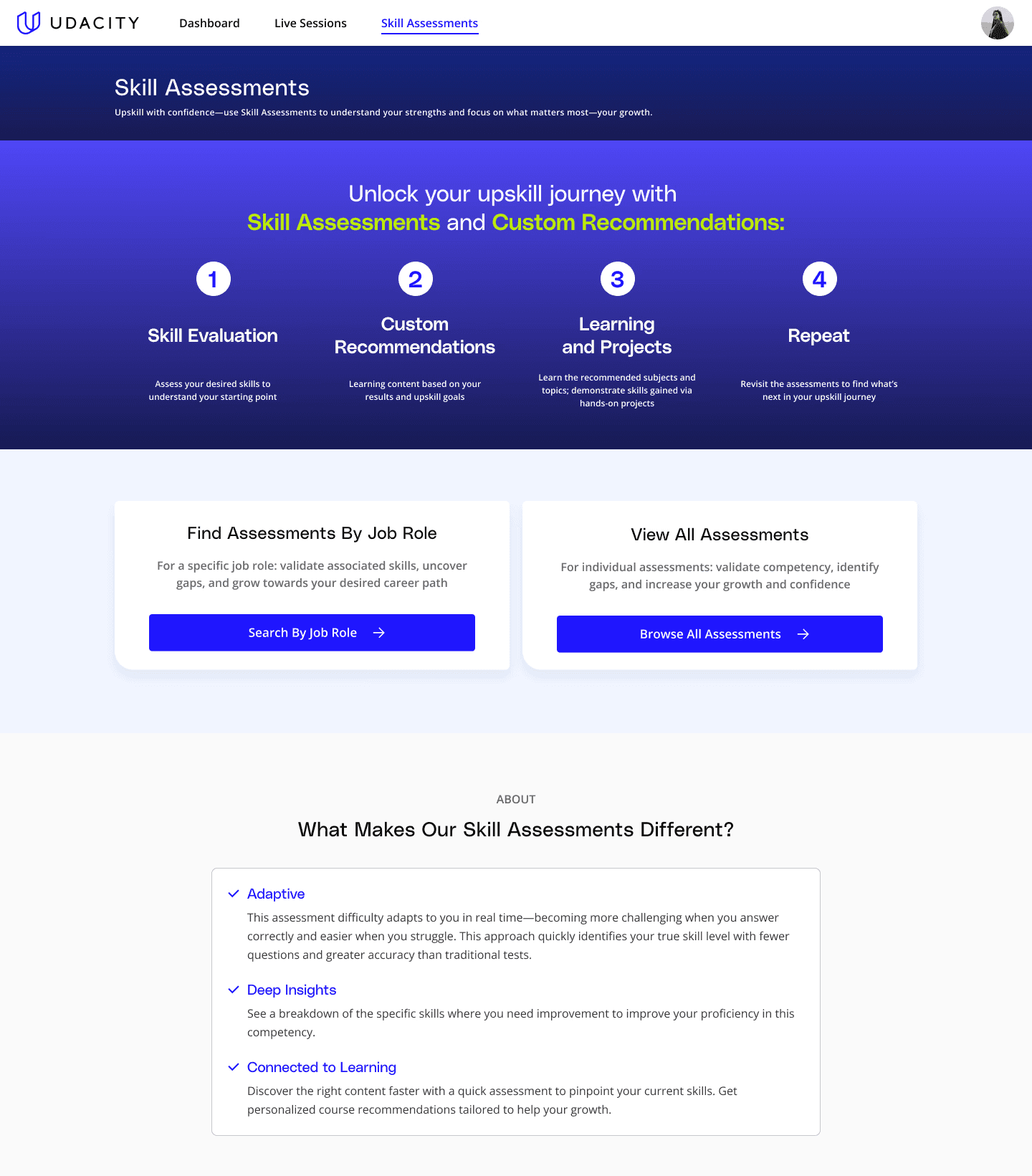
As organizations race to adopt AI, cloud, and data technologies, their ability to measure and close workforce skill gaps hasn't kept pace. Udacity partnered with Accenture's skills intelligence platform, workera.ai, to address this, but the learner experience was fragmented, limiting adoption and value.
I led design on a unified, end-to-end assessment and learning experience that let enterprise learners discover, complete, and act on skill assessments to determine their next learning step, while supporting enterprise scalability, renewals, and revenue growth.


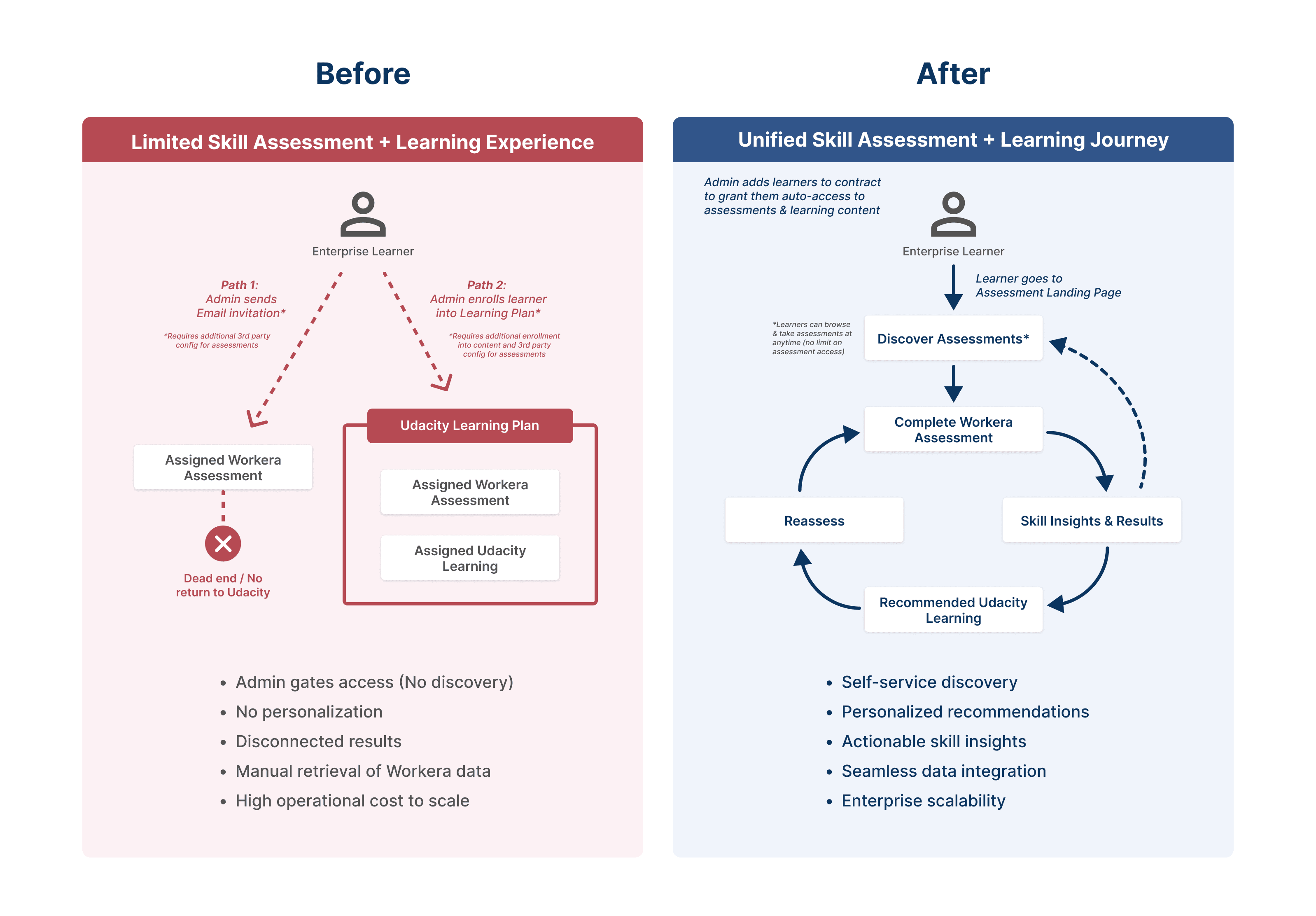
Workera assessments existed inside the Udacity ecosystem, but access required Learning Plan enrollment (high operational cost) and the experience was disconnected from Udacity's learning content. Two breakdowns stood out:
No discovery or entry point: Learners couldn't independently find assessments. Access depended on pre-assigned Learning Plans or email links, blocking proactive exploration.
A broken learning loop: After finishing an assessment on the Workera 3rd party platform, learners hit a dead end. No return path to Udacity, no surfaced results, no connection to relevant content.
The result: weakened learner trust, limited scalability, and no way for Udacity to prove measurable skill growth and value to enterprise customers, even though the underlying assessment technology was strong.

Early research explored two possible entry points into the assessment experience: letting learners browse by specific skill, or by job role.
Skill-based browsing was the more "correct" model on paper — it mapped directly to Workera's taxonomy and gave granular control. But it assumed learners already knew which skills they were missing, which research showed wasn't true. Enterprise learners consistently thought in terms of their job role or career path first, and skills second.
I made the call to descope skill-based discovery for launch and ship role-based exploration as the primary path. This meant less taxonomic precision up front, but a much lower cognitive barrier to entry, enabling learners to find a relevant assessment without first knowing what they didn't know. Skill-based browsing was reframed as a fast-follow rather than a launch blocker, which also reduced scope enough to hit the 5-month enterprise deadline.


I ran a structured but fast-moving process given the timeline and cross-org complexity:
Understand the system: Audited existing Udacity and Workera experiences, interviewed internal stakeholders and enterprise customers, reviewed analogous assessment platforms
Define principles: Assessments should feel actionable (not evaluative); results must be transparent and contextual; every assessment should lead to a clear next step
Explore and validate: Rapid flow mapping and prototype testing with enterprise learners
Refine and launch: Iterated based on usability findings and stakeholder feedback, shipped a high-fidelity MVP
What research told me:
Learners immediately understood the value of assessments, but wanted clearer explanations of scoring and methodology
Personalized recommendations increased motivation and confidence
Job role context was the single most helpful factor in choosing an assessment — which directly validated the role-based decision above
Learners wanted data and benchmarks to understand how their results compared to peers and demonstrate role readiness
The system closed the loop between insight and action, built around a repeatable cycle: Discover → Assess → Understand → Learn → Reassess.
Key components:
Assessment Discovery Hub — a centralized entry point framing assessments as growth tools, not tests
Role-Based Exploration — discovery aligned to how learners actually think about their careers (see decision above)
View All Assessments — discovery allowing users to view and search the full breadth of the assessment catalog
Seamless 3rd-party API integration — Workera's assessment results integrated directly into Udacity, with automatic return and no manual handoff for the learner
Skill taxonomy translation (Workera → Udacity) — mapping two different skill frameworks into one coherent structure, so results made sense in Udacity's own content language and could power Udacity recommendations
Actionable results experience — transparent scores and skill breakdowns tied directly to recommended learning content
AI-generated assessments, designed for trust — see below
Workera's assessments are AI-generated — questions and skill scoring are produced by Workera's AI-powered skills intelligence platform rather than written and calibrated manually by a person for each domain. That's what made the assessment catalog scalable across the breadth of skills enterprise customers needed (AI, cloud, data, and beyond) in a way manual content creation couldn't match on this timeline.
But research surfaced a real risk with AI-generated results: learners didn't inherently trust a score they couldn't explain. Two of the clearest research findings were that assessment and skill results needed clearer explanations of scoring and methodology, and that learners wanted benchmarks to understand their performance in context.
So my design focus wasn't the generation itself — that was Workera's. My job was integrating Workera's API into the Udacity platform and designing how those results were displayed: intuitive enough to build trust, and structured to actively drive learners toward relevant Udacity learning content rather than leaving them with a score and nowhere to go. I designed the results experience to show how a score was reached (skill breakdowns, not just a number), connect each gap directly to a specific recommended next step on Udacity, and give learners enough context to believe the assessment reflected them accurately. Without that layer, an AI-generated score risks feeling arbitrary — and worse, a dead end instead of a path back into Udacity's content.

Workera and Udacity each organize skills using their own framework, and results out of Workera's API didn't map cleanly onto Udacity's content structure. Left untranslated, a learner's skill gap would be described in language that didn't match the courses meant to close it — breaking the exact "understand → learn" link the whole experience depended on.
This turned out to be one of the most time-intensive parts of the project. I worked closely with engineering over several iterations to define how Workera's taxonomy should map to Udacity's — deciding where categories aligned directly, where they needed to be merged or split (or excluded), and where a Workera result had no clean Udacity equivalent and needed a fallback. Alongside that mapping work, I designed how the translated result should actually be displayed to a learner: specific enough to feel accurate to their assessment, but written in Udacity's own content language so the recommended next step felt like an obvious, connected action rather than a jump between two different systems.


Key Outcomes:
Launched a complex, cross-platform MVP in under 6 months
Enabled new backend and frontend capabilities across Udacity and Workera
Contributed to 8 new enterprise customer acquisitions
Supported 5 enterprise renewals during development
Reduced manual enrollment and support workflows via self-service discovery — expanding from 1:1 to 1:many discovery (one enrollment action granting access to a full catalog of content instead of a single assessment)
Metrics I'd track post-launch (I left the company shortly after release, so I couldn't observe these directly, but designed the experience with them in mind):
Assessment discovery and start rates
Completion rate and return-to-Udacity rate post-assessment
Engagement with recommended content following results
Reduction in manual/ops-led enrollments
Learner-reported clarity on next steps
This project required designing across organizational boundaries, aligning learner needs with enterprise constraints, and treating assessments as part of a long-term system rather than a one-off feature. The role-based-over-skill-based decision, and the work of building trust around AI-generated results, were both about the same underlying thing: making a powerful but imperfect system feel legible and reliable to the people using it.
The result wasn't just a new surface experience — it was a durable framework for measuring and closing skill gaps, positioning Udacity to better serve both learners and enterprise customers in a fast-moving skills market.